Logistics · Case study

“Our largest customers wanted proof we deliver on time.”

A global supplier now sends its largest customers delivery and emissions reports that update automatically every month.

Based on actual client work. Client names and sensitive details are removed for confidentiality purposes.

0 → 12

customer reports updated automatically every month

0

wrong figures sent to a customer since go-live

1

definition of “on time”, agreed with each customer

Based on actual client work. Client names and sensitive details are removed for confidentiality purposes.

The problem

A wrong figure reached the customer first.

The largest customers asked for two numbers every month:

Proof of on-time in-full delivery

An emissions figure for every unit shipped

Both go into the customers' own reporting. The reports were put together by hand each month, so a wrong figure could reach the customer first.

At a glance

Company

Company

Global supplier, shipping to large corporate customers

Worked with

Worked with

CFO, finance director, the sustainability lead

Built on

Built on

One central data warehouse, fed by the ERP and shipping data

What we did

What we did

Delivery and emissions definitions, the warehouse, automated customer reports

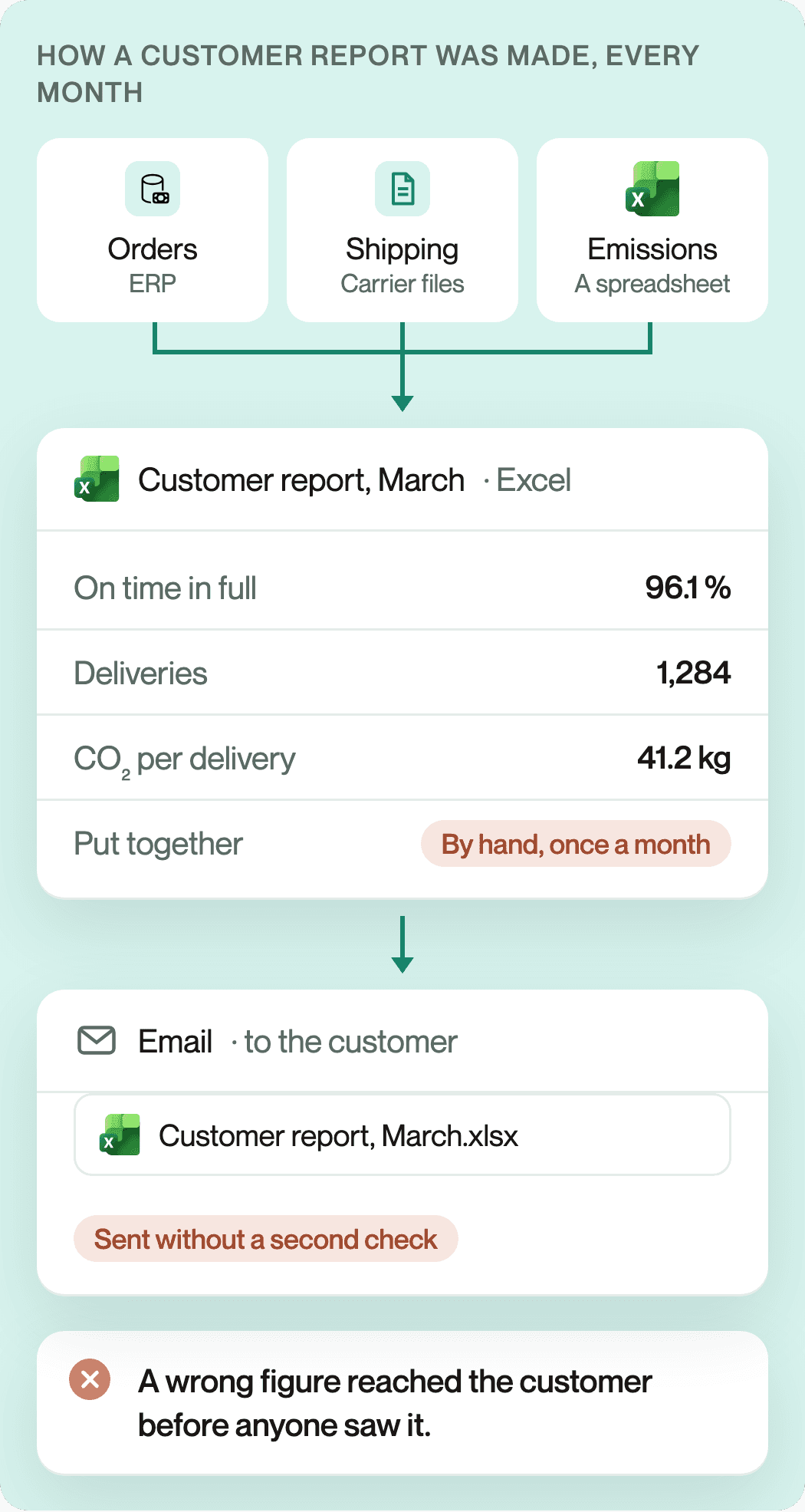
Orders from the ERP, shipping data from carrier files and emissions from a spreadsheet were put together by hand in an Excel customer report once a month. The report was emailed to the customer without a second check, so a wrong figure reached the customer before anyone saw it.

What we built

Definitions, one warehouse, reports that send themselves.

1

Definitions the customer can check

Each definition was agreed with the person who owns it, then checked against the supplier's own delivery records.

How an order is counted against the agreed date: all units before the date is on time in full, all units after the date is late and not counted, and only part of the units before the date is not in full.

2

One warehouse behind every report

All order, delivery and shipping data sits in one warehouse. The company is replacing its ERP, and the customer reports keep running through the move.

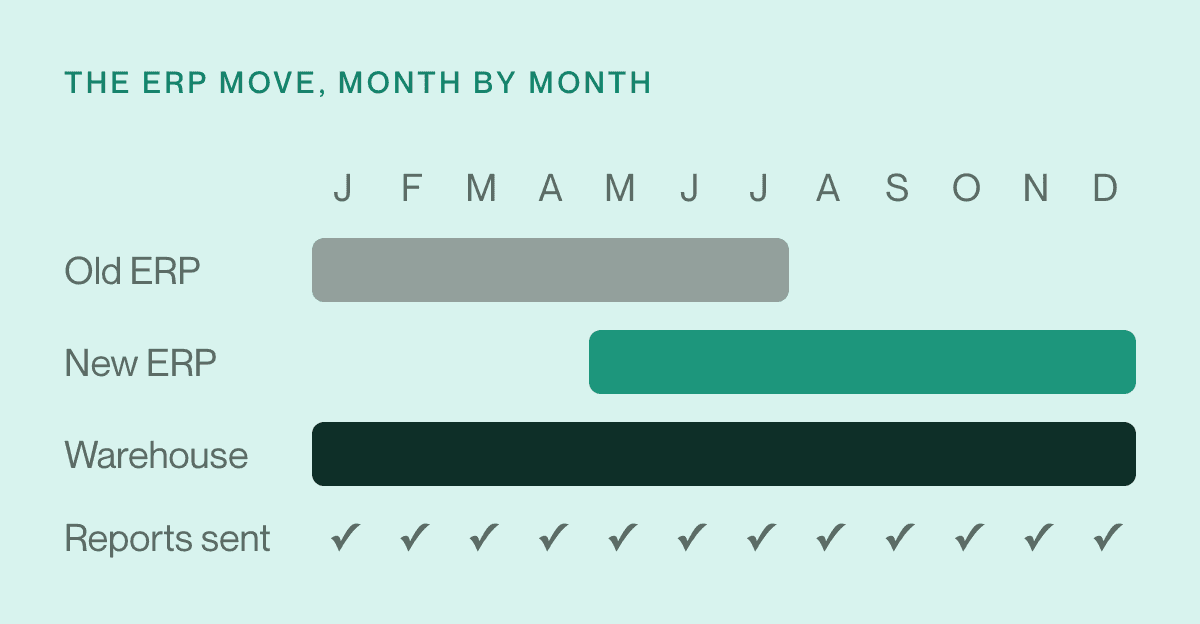
The ERP move over one year: the old ERP runs from January to July, the new ERP from May to December, and the warehouse runs all year, so customer reports went out every month.

3

A report that arrives by itself

Each report refreshes on the first of the month, and the sustainability lead reviews it before it goes out. A new customer means one more report, not a new project.

A March delivery report for Customer A: 96.4% on time in full and 0.82 kg CO2e emissions per unit, reviewed by the sustainability lead and sent on 1 April.

The outcome

Reports the largest customers can rely on.

The largest customers get the same numbers every month, on time.

The largest customers get the same numbers every month, on time.

Nobody at the supplier assembles a customer report by hand.

Nobody at the supplier assembles a customer report by hand.

The ERP can change without breaking what customers see.

The ERP can change without breaking what customers see.

Show us the report nobody trusts.

1 · A 30-minute call.

2 · We look at your current reports together.

3 · We tell you what we would do.

Show us the report nobody trusts.

1 · A 30-minute call.

2 · We look at your current reports together.

3 · We tell you what we would do.

Show us the report nobody trusts.

1 · A 30-minute call.

2 · We look at your current reports together.

3 · We tell you what we would do.

CaseWhen is a Berlin BI consultancy that builds reporting that leaders can trust, on the Microsoft stack: Power BI, Fabric and Azure.

Berlin, Germany

© CaseWhen Consulting GmbH

English

CaseWhen is a Berlin BI consultancy that builds reporting that leaders can trust, on the Microsoft stack: Power BI, Fabric and Azure.

Berlin, Germany

© CaseWhen Consulting GmbH

English

CaseWhen is a Berlin BI consultancy that builds reporting that leaders can trust, on the Microsoft stack: Power BI, Fabric and Azure.

Berlin, Germany

© CaseWhen Consulting GmbH

English